Space Security Intelligence Platform
Orbital Risk Tracker
Mapping real-world space security incidents across orbit, cyberspace, and the electromagnetic spectrum. The Orbital Risk Tracker provides a policy-grade interface for understanding the strategic vulnerabilities of space-based infrastructure.
Enter Platform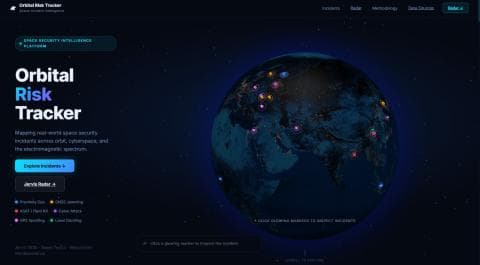
4
Orbital Regimes
6
Incident Categories
12+
Active Constellations
8
Threat Vectors

Capabilities
What This Platform Maps
- Satellite constellation risk mapping and vulnerability assessment
- Orbital debris field tracking and collision probability modeling
- Comprehensive space security incident database with timeline analysis
- Electromagnetic spectrum interference and jamming event cataloguing
- Lunar governance gap identification and institutional fragmentation analysis
- Launch activity monitoring and dual-use capability tracking
Core Features
Analytical Depth
Space Security Incident Database
Comprehensive catalogue of real-world space security events including anti-satellite tests, close-approach maneuvers, signal jamming, and orbital debris-generating events. Each incident mapped by orbital regime, actor, technique, and strategic impact.
Constellation Vulnerability Mapping
Analysis of major satellite constellations—including Starlink, OneWeb, GPS, GLONASS, and BeiDou—assessing single-point-of-failure risks, ground segment dependencies, and cross-link architecture vulnerabilities.
Orbital Debris Risk Assessment
Tracking debris fields generated by ASAT tests and collisions, modeling cascade risk (Kessler syndrome scenarios), and identifying orbital regimes most vulnerable to long-term access denial.
Electromagnetic Spectrum Analysis
Mapping incidents of GPS spoofing, satellite communication jamming, and spectrum interference events. Correlating EM disruption patterns with geopolitical tensions and military operations.
Key Insights
What the Analysis Reveals
Space is no longer a sanctuary—it is an active domain of strategic competition where physical and electronic threats converge.
The concentration of critical infrastructure in specific orbital regimes creates systemic vulnerabilities that affect all domains simultaneously.
Ground segment dependencies represent the most accessible attack surface for adversaries seeking to disrupt space-based services.
Orbital debris from a single destructive event can deny access to entire orbital regimes for decades, affecting civilian and military operations alike.
Cross-Domain Significance
Why This Domain Cannot Be Analyzed in Isolation
Orbital systems underpin nuclear command-and-control, enable cyber operations through satellite communications, shape the infrastructure upon which lunar governance depends, and create dependencies that cascade across all strategic domains when disrupted.

Explore the other strategic layers